
The short answer: The choice depends on the cavity, available depth, moisture design and building use. Both foams can insulate and air-seal when installed as specified; compare the product and assembly rather than choose by foam color or a single thickness.
What open-cell and closed-cell foam are
Spray foam starts as two liquids that meet at the gun, react, and rise into solid plastic almost at once. The two foams differ in their bubbles. In open-cell foam the tiny cells burst as it rises, leaving a soft, spongy foam of about half a pound per cubic foot.
Closed-cell foam keeps its cells sealed. Each holds a gas that slows heat better than air, and the cell walls are thicker, so the foam is hard and close to two pounds per cubic foot. Press a thumb into each: open-cell gives like a sponge, closed-cell barely moves.
How the two foams behave differently
On paper, closed-cell has the edge. It packs roughly twice the R-value into each inch, shrugs off liquid water, and at a couple of inches thick slows vapor enough to count as a vapor retarder. It also bonds to the framing, sheathing or steel it lands on and can add rigidity to the assembly. It can improve a wall’s resistance to sideways forces, known as racking, with the improvement depending on the product, thickness, and construction.
Open-cell earns its place differently. It costs less per inch, fills deep cavities easily and soaks up sound. Both foams stop air, and with hot afternoons, cold nights and dusty spring wind, sealing leaks matters as much as R-value. The tradeoff: open-cell lets vapor through and holds water if soaked.
- Feel: open-cell is light and soft, closed-cell dense and hard
- Heat: closed-cell holds roughly twice the R-value per inch
- Moisture: closed-cell resists water and vapor, open-cell does not
- Strength: closed-cell can add rigidity, depending on the product, thickness, and construction; open-cell stays soft and flexible
- Sound: open-cell absorbs more noise
| Question | Open-cell | Closed-cell |
|---|---|---|
| How much space is available? | Needs enough cavity depth for the specified insulation value. | Provides more insulating value per inch, with the actual value set by product data. |
| How does the assembly dry? | More vapor-permeable; moisture control must suit the roof or wall. | Vapor resistance depends on thickness and the specified product. |
| What else needs review? | Ventilation, air sealing and required protective finishes still matter. | Substrate, moisture, fire protection and assembly details still matter. |
Where each foam belongs in your house
Open-cell can suit deeper roof and wall cavities when the complete assembly allows it. Available depth, moisture and drying, required protection and how the space is used matter more than a blanket rule for every home.
Closed-cell goes where moisture, strength or space is the problem. Rim joists, where floor framing meets the foundation, leak cold air near the ground. Crawl space walls back up to damp soil. Metal buildings need a layer that keeps the steel above the dew point. Shallow walls and cathedral ceilings need more R-value per inch.
Ducts in the attic change the answer
In many New Mexico houses with pitched roofs, the ducts, and often the furnace or air handler, sit in the attic. On a summer afternoon that attic runs far hotter than the yard, so cooled air warms before reaching the rooms, and every leaky joint pulls in dusty attic air.
Foam on the attic floor leaves those ducts out in the heat and cold. Foam under the roof deck, with the attic vents closed, makes the attic a sealed space much closer to indoor temperature, so the ducts sit inside the insulated house. With ducts up there, the roof deck is usually the right place for foam.
In the high, cold towns, Santa Fe, Ruidoso and Cloudcroft among them, a foamed roof deck also has to handle winter vapor, so the deck often gets closed-cell or open-cell with a vapor-retarding coat; we check the local code for each job. A swamp cooler that relieves damp air into the attic needs a new path outdoors before the attic is sealed, which gets worked out in planning, sometimes with your HVAC contractor.
Airing out, staying out and covering the foam
While the foam goes on, and for a while after, it gives off vapors nobody should breathe unprotected. Ventilation goes in before spraying starts, and people and pets stay clear until the area has aired out. How long depends on the product, and we tell you before the job, not after.
Foam is a plastic, and plastic burns. Codes want it separated from living space by a thermal barrier, usually half-inch drywall. In an attic or crawl space entered only for service, a lighter ignition barrier or approved coating is often allowed. Which applies depends on the product, the space and local code, so it is checked every time.
How the choice gets made on site
Nobody should pick a foam from a brochure. We start by looking at the roof framing and deck, where the ducts run, what insulation is up there today, how any swamp cooler vents, and whether the crawl space or rim joists show damp. Roof leaks and wet wood need fixing first: foam does not cure water problems.
Ducts, cavity depth, moisture, noise and the local code then decide each spot, so many houses end up with both: open-cell on the roof deck and in the walls, closed-cell at the rim joists and crawl space. Your written estimate names the foam and thickness for every area, so you see what goes where before anyone sprays.
- Show which roof, wall or floor cavities are accessible and how deep they are.
- Identify attic ducts, heating equipment and any evaporative cooler.
- Point out roof leaks, damp areas or old insulation before they are covered.
- Ask the written scope to name the product, thickness by area, preparation and required finishes.
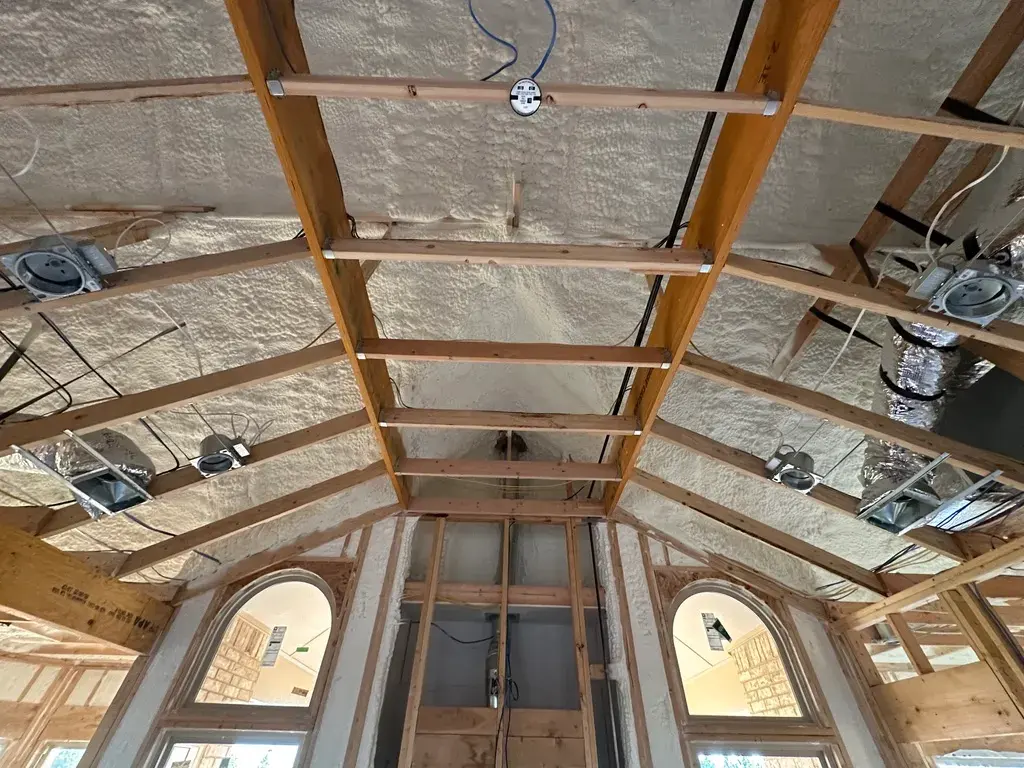
On this Artesia new-home job, foam follows the roof deck above the framing and exposed ducts. The photo shows where the insulation goes; product selection and thickness come from the written scope.
See this Artesia projectFurther reading
In short
- Closed-cell packs more R-value per inch and handles moisture, so it suits rim joists, crawl spaces and metal buildings.
- Open-cell needs room for the specified thickness; the assembly, climate and moisture design guide the choice.
- With ducts in the attic, foam under the roof deck usually beats foam on the attic floor.
- A swamp cooler that vents into the attic needs a new relief path before the attic is sealed.