
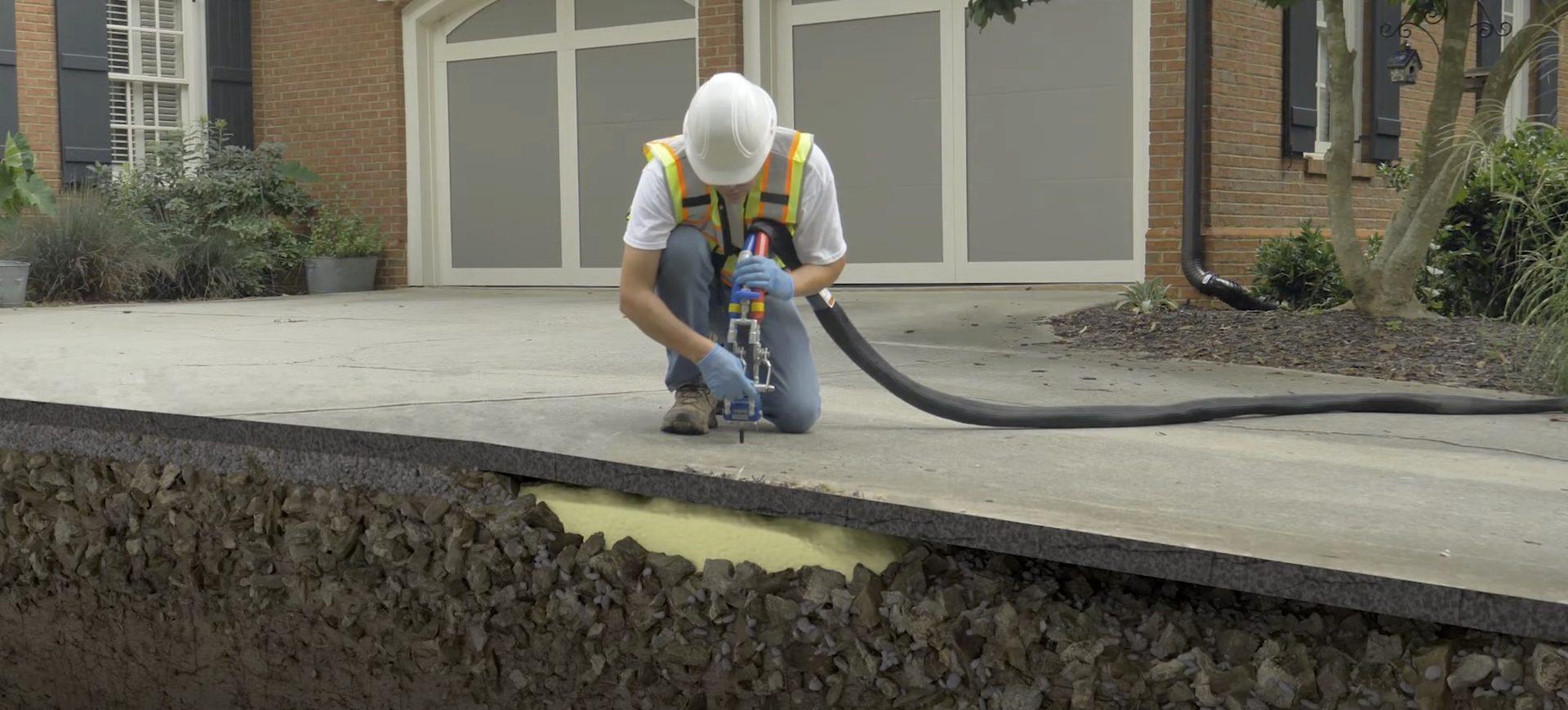
Technician injecting polyurethane foam through a small hole to lift a sunken driveway slab in front of a garage

Concrete driveway lifting and leveling

Concrete Driveway Lifting & Repair

We lift sunken driveway panels back to grade with polyurethane foam injection, without tearing out the slab.

What we look at first

A low driveway panel doesn’t mean the concrete has to be replaced. We look at the slab’s condition, how it meets the garage and sidewalk, where the water goes, and what changed underneath, then lift it to match its neighbors so the trip hazard and the puddle are gone.

Signs it’s time to have it looked at

  • A noticeable drop where the driveway meets the garage floor
  • Vertical offsets between adjacent driveway panels
  • Water collecting in a low section after rain or irrigation
  • A slab edge that sounds hollow or lacks visible support
  • Cracks that opened as neighboring sections moved
  • An uncomfortable transition at the street, curb, or walkway

Why it settled

Water

Runoff, irrigation, a leaking line, or a downspout aimed at the slab washes the soil out from under it.
Fill that kept settling

The dirt under a driveway is often fill from construction. If it was not compacted evenly, it keeps sinking for years.

Soil that swells and shrinks

Some New Mexico soils change volume as they get wet and dry out, and the slab moves with them.

Weight over a weak spot

Vehicles find the unsupported spot. The load is rarely the cause on its own, but it is what finally cracks the slab.

What we check before we lift

  • The number, size, and condition of the affected driveway panels
  • The elevation at the garage, sidewalk, curb, joints, and drainage paths
  • Crack patterns and whether the slab can move without breaking further
  • Visible washout, erosion, leaking water, or unsupported slab edges
  • Access for drilling, injection equipment, and safe traffic control

Things to plan around

The garage lip

Level is not the goal; matching the garage floor and the neighboring panels is. We lift to take out the lip without sending water into the garage.

Where the water goes

Raising a panel changes how water runs off. We look at the grades around it and tell you what lifting will and will not fix.

Parking

You will need to keep vehicles off the treated panels for a while after we finish. We put the timing in writing for the material we use.

Lifting is a good fit when

  • The slab is in one piece, or a few solid pieces
  • The garage floor and neighboring panels give us a clear height to match
  • The water problem that caused it can be fixed or redirected
  • We can get our equipment to the slab

Replacement is the better call when

  • The concrete is broken into many pieces or crumbling
  • Lifting would leave a bad slope or a worse transition at the garage
  • A leak or drainage failure is still active and would sink it again
  • The driveway itself needs to be redesigned, not just raised

Concrete Driveway Lifting & Repair FAQs

Lifting fixes the height, not the cracks. Cracks usually close up some as the panels come back into line, but they stay visible. We can point you to a crack repair if you want them sealed.
We lift to match the garage floor, the sidewalk, and the neighboring panels, and keep the slope that sheds water. We agree on that target with you before we start.
That depends on the material and the weather that day, and it goes in your written estimate. Keeping vehicles off the treated panels for the stated time is the main thing we ask.
It usually is, because there is no demolition, hauling, forming, or new concrete, and you are not waiting a week to drive on it. The estimate depends on how many panels moved and how far. We will tell you if replacement is the smarter buy.

Find out whether your slab is a good candidate

Schedule a site visit or send plans so we can assess the concrete and what it connects to. After the visit or plan review, we’ll explain whether lifting, replacement, or another fix makes sense and provide a free written estimate.