
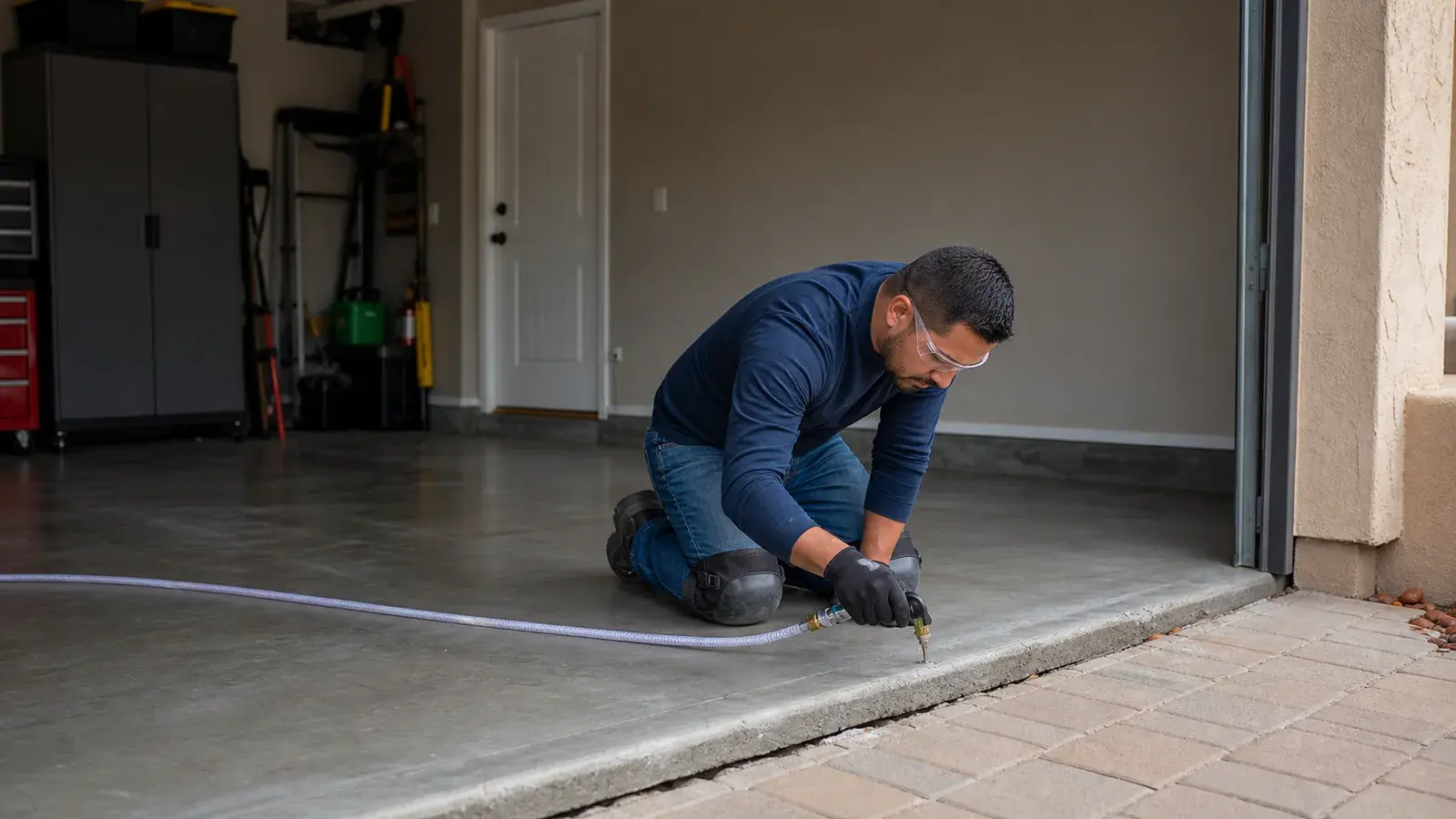
Technician injecting polyurethane to lift a settled garage floor slab

Sunken garage slab lifting

Garage Floor Lifting & Leveling

We lift sunken garage floors back to level with polyurethane injection, working around the overhead door, walls, thresholds, and drains.

What we look at first

A garage slab that has dropped leaves a gap under the overhead door, a bump at the driveway, and a floor that no longer meets the walls. We measure those fixed points and check the slab’s condition, then lift it back to where it belongs.

Signs it’s time to have it looked at

  • A gap beneath one side of the garage door
  • Water collecting in an unintended low area
  • A step or lip between the garage and driveway
  • Visible separation at a wall or threshold
  • A hollow sound or unsupported slab edge
  • Cracking associated with a settled floor section

Why it settled

Settled fill

The garage slab and the apron usually sit on fill placed during construction, and it settles unevenly.
Water

Runoff, a plumbing leak, or bad drainage next to the garage softens or removes the soil under the floor.

Utility trenches

A backfilled plumbing or utility trench under the floor settles differently from the ground around it.

The floor moves on its own

Most garage floors are not tied to the walls or footings, so the slab drops while the walls stay put.

What we check before we lift

  • Floor elevations at the overhead door, walls, thresholds, and drains
  • Whether the floor is structurally separate from walls and footings
  • Known plumbing, utilities, radiant heat, or floor coatings
  • Crack condition and the ability of sections to move
  • Equipment, storage, vehicle access, and ventilation needs

Things to plan around

The overhead door

We lift to close the gap under the door without making the door bind or leaving a lip at the driveway.

Drains and slope

Many garage floors are sloped on purpose. Level is not always the target; draining the right way is.

What is in the slab

Drains, anchors, a lift, radiant heat, or a coating change how we drill and inject. Tell us what you know and we locate the rest.

Lifting is a good fit when

  • The settled section is solid enough to move
  • The floor moves independently of the walls and footings
  • The door and thresholds give us a clear height to match
  • We can work around what is in and under the slab

Replacement is the better call when

  • The floor is tied to structure that should not move
  • The slab is broken up or badly deteriorated
  • The floor needs new drainage or reinforcement
  • A leak or structural problem is still unresolved

Garage Floor Lifting & Leveling FAQs

If the floor dropped, yes: we bring the slab back up to meet the door and the driveway. If the door or tracks are the problem, we tell you that instead.
Not usually. Most are sloped toward the door or a drain on purpose, and we keep that.
Yes. The injection holes interrupt the coating at each spot, and the patches will show. We keep them small and talk it through first.
It depends on the material and conditions that day. The timing goes in your written estimate, and we go over it at the walk-through.

Find out whether your slab is a good candidate

Schedule a site visit or send plans so we can assess the concrete and what it connects to. After the visit or plan review, we’ll explain whether lifting, replacement, or another fix makes sense and provide a free written estimate.