
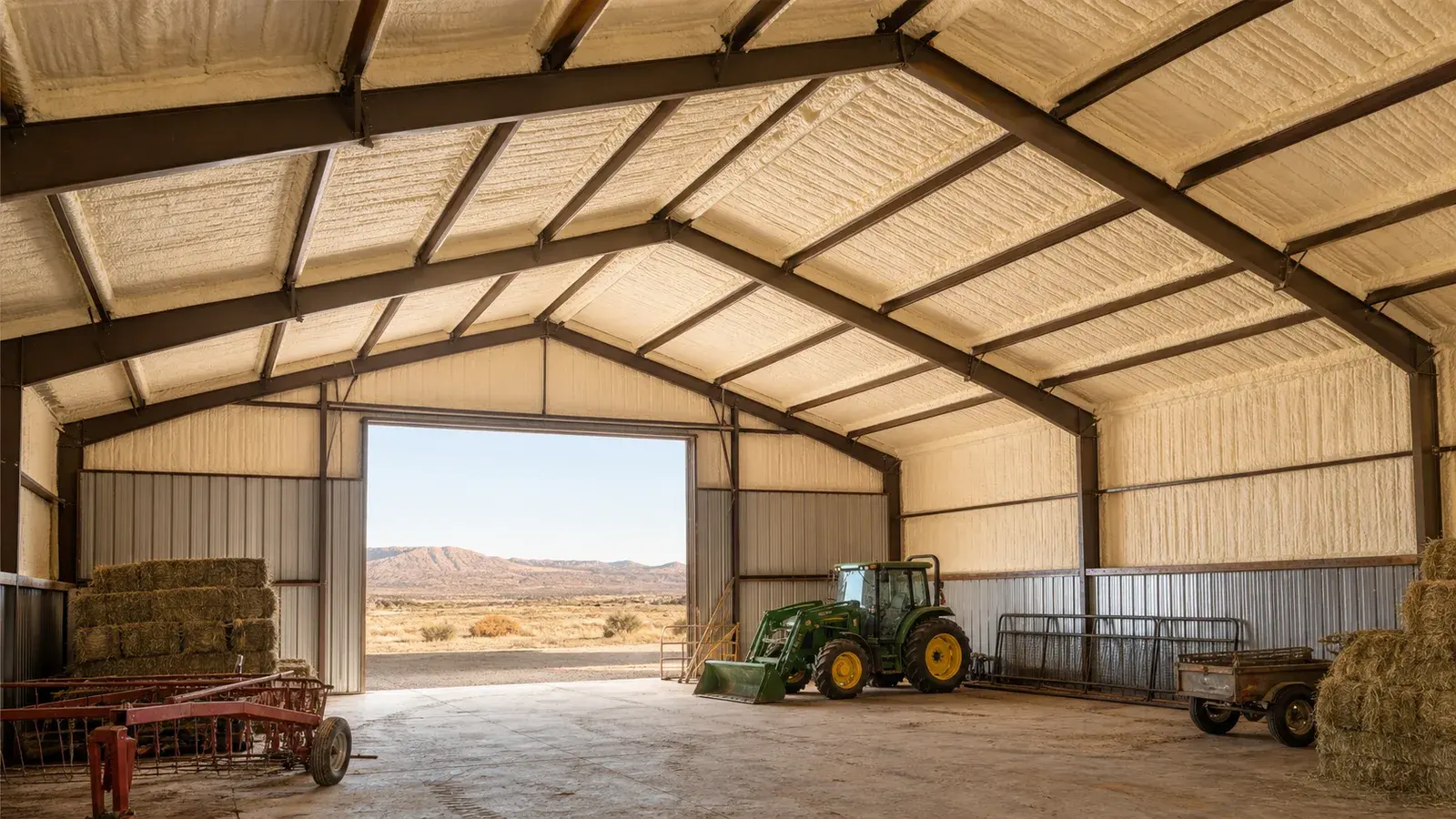
Agricultural insulation
Spray Foam Insulation for Barns & Farm Buildings
Spray foam for barns, farm shops, livestock buildings, and equipment storage across New Mexico and West Texas.
Barns, shops, and storage buildings
Ag buildings take a beating from heat, cold, wind, moisture, and washdown. Spray foam seals and insulates in one pass, and we plan each job around the animals, stored products, and ventilation the building has to handle.
If the metal roof leaks at the screws or seams, we can seal and coat it in the same visit. See metal roof restoration.
Livestock barns & shelters
Barns and shelters that stay more comfortable in July and January, with less condensation dripping on animals and bedding. We plan the foam around your ventilation.
- • Cattle barns and dairy facilities
- • Horse stables and training facilities
- • Poultry houses and coops
- • Sheep and goat shelters
Storage & warehouse buildings
Keep feed, grain, and equipment out of the temperature swings and the moisture that comes with them.
- • Grain storage facilities
- • Equipment storage buildings
- • Feed storage warehouses
- • Cold storage facilities
Processing & workshop areas
Shops and processing areas you can actually work in year-round. We account for equipment, chemicals, and fire-protection requirements.
- • Milking parlors
- • Feed processing facilities
- • Equipment maintenance shops
- • Greenhouse structures
Why spray foam suits ag buildings
Ag buildings are usually bare metal over open framing, which is exactly where spray foam earns its keep.
Easier to heat and cool
Sealing and insulating the shell takes a big load off any heating or cooling you run in livestock areas and temperature-sensitive storage.
Sweating steel
Foam on the panels keeps the steel from sweating onto animals, feed, and equipment. Ventilation still has to handle the moisture the building makes.
Gaps, dust, and pests
Foam seals the gaps that let in dust, wind, and pests. It helps a pest-control plan; it isn’t one by itself.
Washdown-ready
Closed-cell foam also stiffens the panels and stands up to washdown better than batts or blanket insulation.
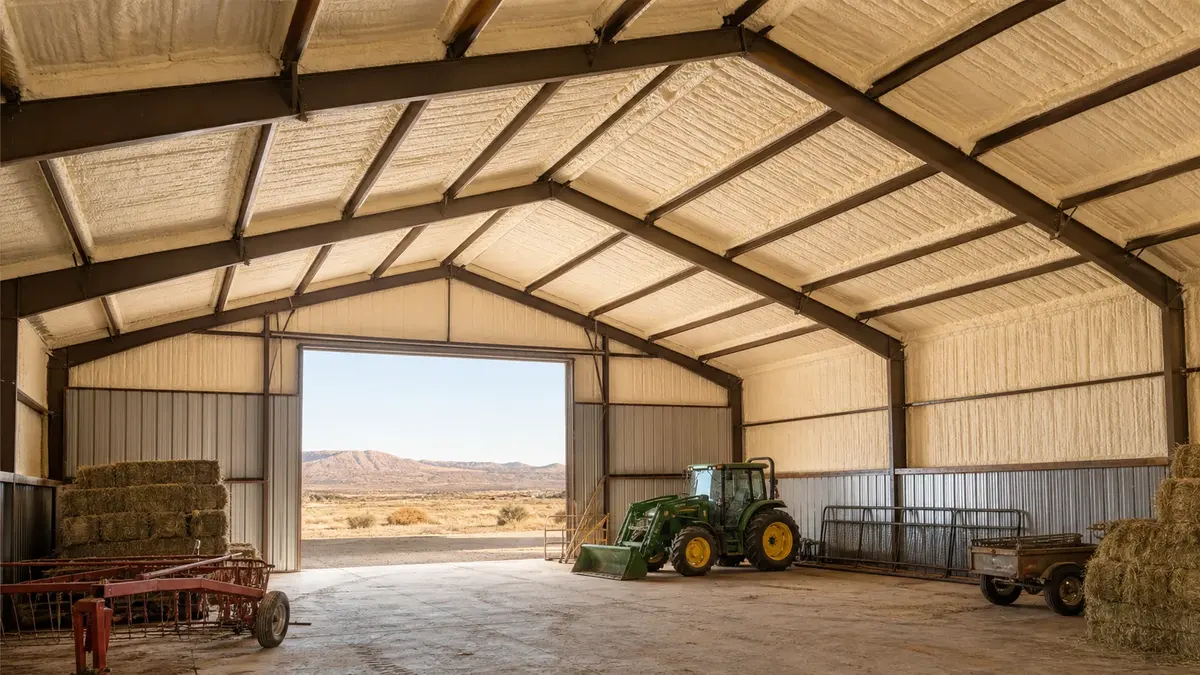
Built for New Mexico’s climate
Hot summers, cold nights, wind, and dust are hard on animals, stored feed, and equipment. Here’s how insulation fits into the picture.
Heat
Insulation slows the heat moving through the shell; ventilation and equipment do the rest, so we look at the whole building.
Air leaks
Sealing the seams and gaps cuts the dust and wind that blow through a metal building, without closing off the ventilation you need.
Moisture
Humidity is a ventilation job; insulation keeps surfaces warm enough that the moisture doesn’t condense on them.
The right foam for how the building is used
A hay barn, a milking parlor, and a tractor shed do not get the same job. Tell us how the building is used and we match the foam, thickness, and any coating to it.
What we consider when choosing the foam
- What lives or is stored inside: animals, feed, grain, equipment
- Washdown, ventilation, and how much moisture the building sees
- The condition of the panels and what prep the foam needs to bond
- Food-safety, animal-care, and fire rules that apply to the building
- Your operating schedule, so animals and work are not in the way of the spray
What we confirm before we spray
- The foam is approved for the surface and the thickness in the estimate
- Whether an ignition or thermal barrier coating is required over the foam
- How long the building needs to air out before animals and people go back in
- The manufacturer’s current data sheets, so the warranty holds
Agricultural Insulation FAQs
Have a barn or shop to insulate?
Tell us about the building and how you use it, and we’ll help arrange a site visit, or you can send us your plans.
Guides
Worth reading before you call
Where we insulate farm and ranch buildings
Agricultural buildings are spread out by nature. We travel across New Mexico and West Texas for barns, shops, and storage buildings; tell us where the property is and we'll confirm scheduling.
Common project areas
We do agricultural insulation across New Mexico, El Paso, and parts of West Texas. Most of that work is in and around:
- Ruidoso
- Alamogordo
- Cloudcroft
- Las Cruces
- El Paso, TX
- Roswell
- Artesia
- Carlsbad
- Hobbs
- Lovington
- Albuquerque
- Santa Fe