
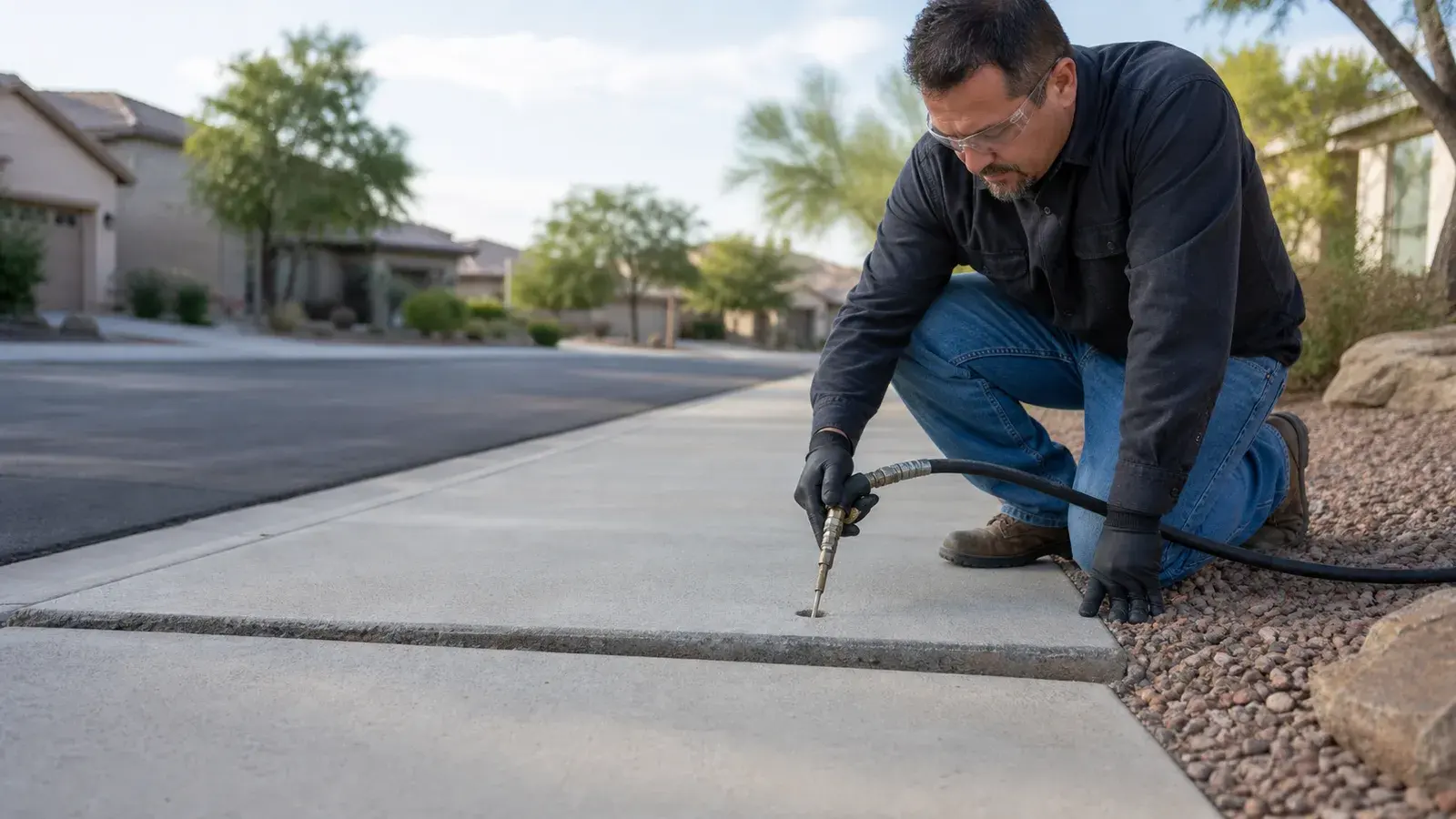
Technician injecting polyurethane foam to raise a sunken sidewalk panel

Concrete walkway lifting and repair

Sidewalk Lifting & Leveling

We raise sunken sidewalk panels with polyurethane injection to take out the offsets that catch toes, wheels, and water.

What we look at first

A lip between sidewalk panels is a trip hazard and, on a commercial property, a liability. We measure the offsets and how the walk meets steps, driveways, and curbs, then lift the low panels to close the gap. If the walk is in the public right-of-way or an HOA is involved, we’ll help you sort out who has to sign off.

Signs it’s time to have it looked at

  • A vertical edge between neighboring sidewalk panels
  • A panel that rocks or moves under foot
  • Water pooling or running beneath the walkway
  • A gap below an exposed slab edge
  • Separation where the walk meets steps or a driveway
  • Cracking concentrated around a settled section

Why it settled

Washout

Water running along an edge or under a joint takes the soil with it, and the panel drops.
Tree roots

Roots push panels up; a root that was cut out rots and leaves a hollow. We can lift the low neighbor, but a root-raised panel usually needs a different fix.

Fill that was never compacted

Walkways are often poured over loose fill that keeps settling after the concrete is in.

Changes around the walk

New landscaping, irrigation, and nearby construction send water and soil movement toward the sidewalk.

What we check before we lift

  • Panel condition and crack pattern
  • Height differences at each joint and adjoining surface
  • Water routes, downspouts, irrigation, and visible erosion
  • Nearby roots, utility features, steps, curbs, and ramps
  • Pedestrian routing and safe access during the work

Things to plan around

Accessibility

Lifting takes out the offset at a joint. It does not, by itself, make a route ADA-compliant; slopes and clearances along the whole route are a separate review.

Roots and utilities

Foam does not remove roots or fix a broken line under the walk. If those are the problem, we will say so and may bring in another trade.

Public sidewalks

Who owns the walk and whether a permit is needed varies by city and HOA. We will help you find out before anyone drills.

Lifting is a good fit when

  • The low panel is in one piece
  • The neighboring panels give us a clear height to match
  • We can drill and inject without hitting roots, lines, or fixtures
  • The washout or drainage problem can be addressed

Replacement is the better call when

  • A root has pushed the panel up rather than a neighbor dropping
  • The panel is badly broken or the surface is crumbling
  • The walk needs to be re-laid out or re-graded
  • The city or HOA requires another repair method

Sidewalk Lifting & Leveling FAQs

That is the point of the job. We raise the low panel to meet its neighbor and take the offset out. What is left depends on the condition of the concrete and how far it moved.
Not on its own. Compliance covers the whole route, not one joint. If that is what you need, we will tell you what lifting can fix and what needs a broader review.
Usually we lift the low panel next to it to even out the transition. The raised panel itself needs the root dealt with or the panel replaced.
It depends on the city and sometimes the HOA. We ask before scheduling so you are not paying for a walk that is not yours to fix.

Find out whether your slab is a good candidate

Schedule a site visit or send plans so we can assess the concrete and what it connects to. After the visit or plan review, we’ll explain whether lifting, replacement, or another fix makes sense and provide a free written estimate.