
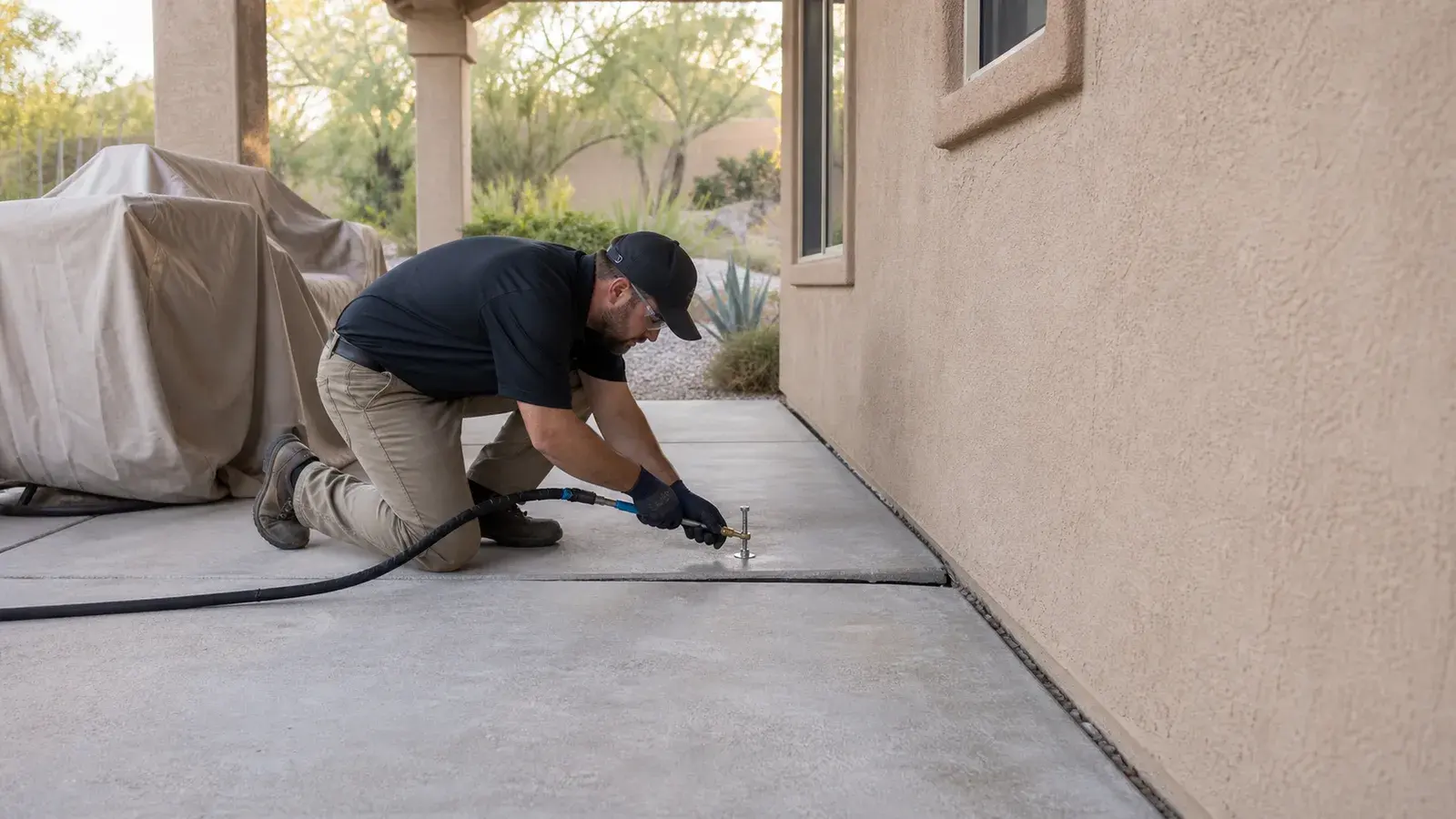
Technician drilling an injection hole to lift a sunken patio slab beside a house

Sunken concrete patio lifting

Concrete Patio Lifting & Repair

We lift settled patio slabs back to level without tearing out your outdoor space, and we make sure the water still drains away from the house.

What we look at first

A patio that has settled toward the house sends water at your foundation and leaves a step at the back door. We check how the slab meets the house, landscaping, drains, and any adjoining concrete, then lift it to a height that drains correctly and meets the door the way it should.

Signs it’s time to have it looked at

  • Water remaining against the building after a storm
  • A low panel beside a door, step, or walkway
  • Visible space beneath a patio edge
  • Rocking, movement, or hollow-sounding areas
  • Cracks associated with a change in elevation
  • Furniture or outdoor features sitting noticeably out of position

Why it settled

Roof and irrigation water

Downspouts and sprinklers that dump next to the slab keep the soil wet or wash it away.
Fill against the house

The ground next to a foundation was dug out and backfilled when the house was built, and that fill settles more than undisturbed soil.

Landscape changes

New beds, a removed tree, edging, or regrading change where the water goes and what holds the slab up.

Sections poured at different times

An addition to the patio settles on its own schedule, so one section drops away from the other.

What we check before we lift

  • Slope relative to doors, walls, and drainage points
  • Crack and joint locations
  • Downspouts, irrigation, planters, and visible washout
  • Attached covers, posts, kitchens, railings, or utilities
  • Whether moving the slab could affect adjacent features

Things to plan around

Water and the house

We lift so the patio drains away from the house, not toward it. Lifting does not replace gutters, drains, or grading that are missing.

What is attached

Posts, railings, an outdoor kitchen, masonry, or a cover can limit how far the slab can move. We plan around them.

Finishes

Stamped, colored, or coated concrete shows the patched holes more than plain grey does. We keep the holes small and tell you what to expect.

Lifting is a good fit when

  • The slab is intact enough to move as a unit
  • There is room to raise it at the door and at anything attached
  • The right height also sends water away from the house
  • The water or fill problem that sank it can be dealt with

Replacement is the better call when

  • The slab is broken into many pieces or crumbling
  • Attached structures make it unsafe to move
  • You want a different size, slope, or drainage design
  • Raising it would create a problem at the door or the steps

Concrete Patio Lifting & Repair FAQs

Often, yes. It depends on how much height we have to work with at the door and what the yard does beyond the slab. We check the grades before we set a target.
Usually. We locate the posts, footings, and roof connections first, because the slab has to move without stressing them.
The holes are about the size of a dime and get patched. On aged or decorative concrete the patches are visible up close.
Yes, when it can move on its own and meet its neighbors. The site visit tells us how much of the patio actually needs work.

Find out whether your slab is a good candidate

Schedule a site visit or send plans so we can assess the concrete and what it connects to. After the visit or plan review, we’ll explain whether lifting, replacement, or another fix makes sense and provide a free written estimate.